
Starlink
A guide for cruising sailors in the South Pacific as of September 2026
The Best Option for Most Cruising Sailors
Most cruising sailors spend most of their cruising season in one or two countries. The Roam Unlimited plan offers the best value for these sailors. Unlimited data for a low monthly fee. $6/GB when offshore.
Our options look like this (using Fiji as an example):
- Roam Unlimited: $109 USD/mo ($6/GB offshore in late September)
- Personal Maritime: $185 USD/mo ($6/GB offshore)
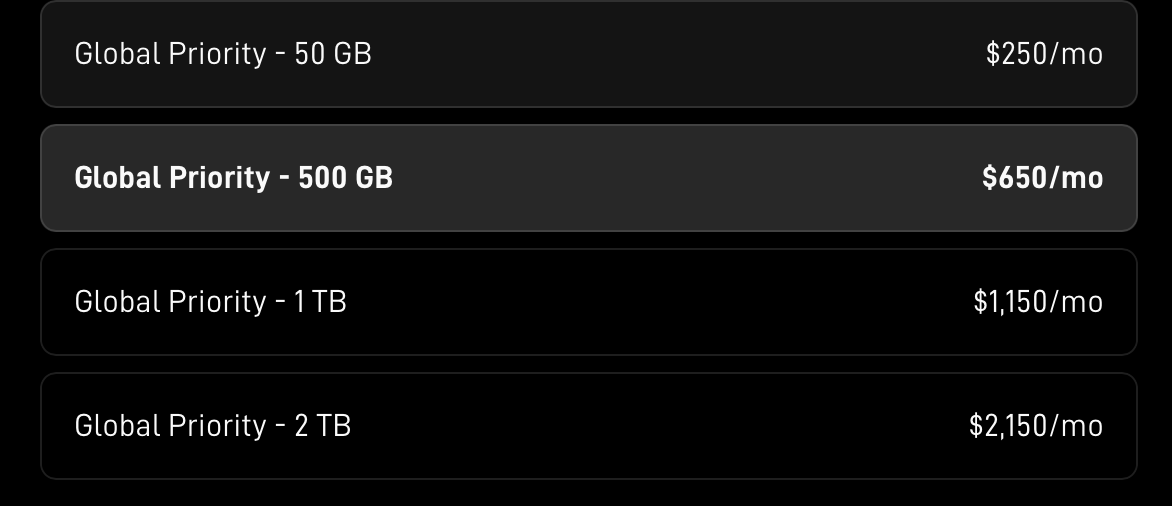
- Global Priority: $650 USD/mo (offshore included)
Roam Unlimited Service Plan
- Service Address: Choose a service address in the country in which you are mainly sailing. We use a marina in Fiji as our address since we spend most of our cruising season in Fiji.
- Switching Accounts & Countries: When we sail down to New Zealand, we'll transfer our dish to a New Zealand account and choose the Roam Unlimited plan there.
- $240FJD/mo ($109 USD/mo) for unlimited data
Personal Maritime Plan
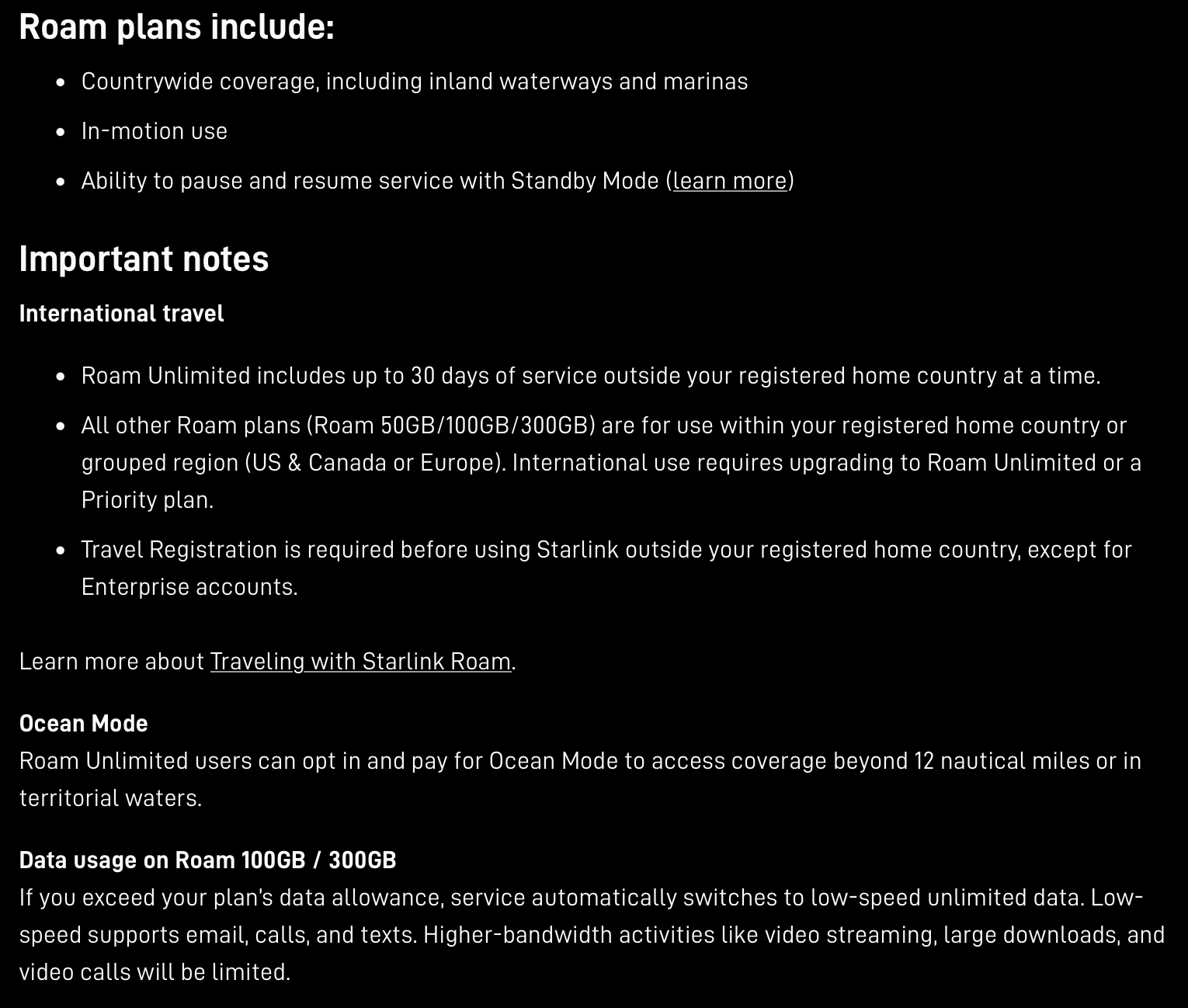
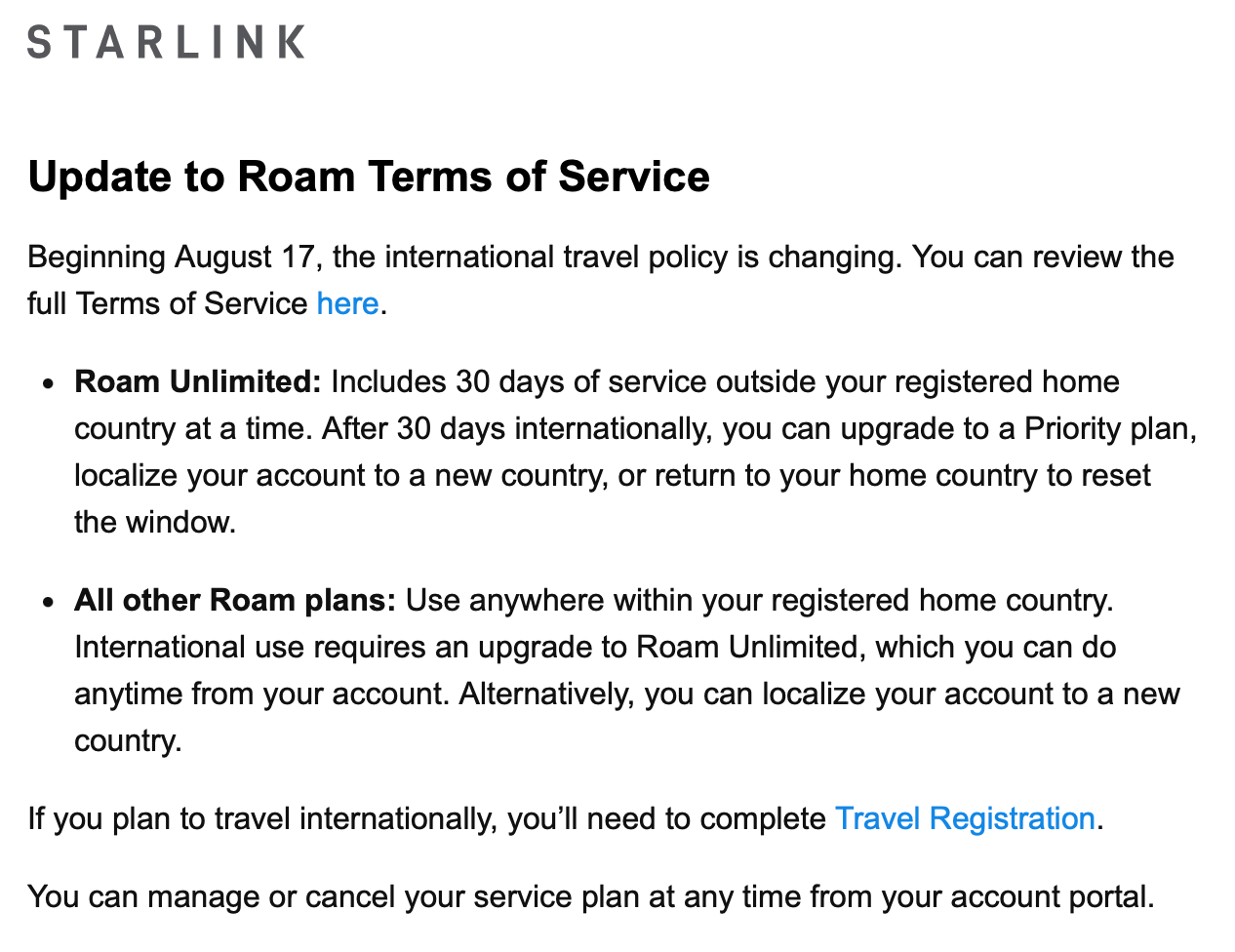
Starlink began offering a "Personal Maritime Plan" in August 2026. It's aimed at cruising sailors who are moving from country to country. It costs more than Roam Unlimited, but it eliminates the need to transfer your dish from account to account when you exceed 30 days outside your service address country.
Sailors crossing the Pacific, sailing through French Polynesia, the Cook Islands, Tonga, Fiji, etc may benefit from this option.
- $185/month USD, excluding applicable taxes
- Unlimited data and use in territorial waters worldwide
- Ocean Mode available beyond 12 nautical miles for $6/GB
- No 30-day Roam international travel limit, except in extremely rare cases when required by local regulations
This plan is for small personal vessels—not yachts or commercially operated vessels (including ferries and commercial fishing)—and is not intended for use on land. Currently, the plan is limited to vessels with a LOA of 60' or less.
Subscribers request this plan from Starlink support and supply basic information about the vessel including:
- Vessel name
- Flag state
- Length overall (LOA)
- A unique ID (such as Hull Identification Number, Craft Identification Number, MMSI, or ITU Call Sign)
- A copy of your vessel's Registration Certificate
Global Priority Plan
This plan is aimed at business users. It has no roaming restrictions. It differs in that you must select a data package along with the subscription.
Since we use around 400GB of data per month on our Roam Unlimited plan, we'd need to buy the 500GB data option for the Global Priority Plan to work for us.
If you have the budget for it, this can be a good option. You are assured the best possible speeds. You don't have to worry about roaming restrictions. You don't have to remember to activate "Ocean Mode" when you sail offshore.
15 July 2026 Update: Change in Terms for Roam Unlimited
Starlink updated the terms for Roam Unlimited in mid-July. They "may" limit the use of the plan outside of the service address country to 30 days. As yet, we aren't aware of anyone who has had this restriction imposed upon them.
This new restriction is somewhat mitigated by the release of the new Personal Maritime Plan which doesn't have a 30 day limit.
Comparison of South Pacific Options
Roam Unlimited Plan for common service address countries normalized to USD (per month):
- Vanuatu: $11,400 VUV (~$95USD)
- Papua New Guinea: $420 PGK (~$96USD)
- Tonga: 240 TOP (~$100 USD)
- Samoa: $280 WST (~$102USD)
- American Samoa: $105 USD
- Panama: $105 USD
- Mexico: $2,150 MXP ($106 USD)
- Fiji: $240 FJD (~$109 USD)
- Marshall Islands: $110 USD
- Solomon Islands: $890 SBD (~$111USD)
- Malaysia: $455 MYR (~$115)
- Kiribati: $170 AUD (~$122USD)
- Tuvalu: $170 AUD (~$122USD)
- Cook Islands: $220 NZD (~$131NZD)
- NZ: $235 NZD (~$140 USD)
- Niue: $235 NZD (~$140 USD)
- Australia: $210 AUD (~$151 USD)
- United States: $175 USD
Changing Your Account and Service Address to a New Country
If your current service address country doesn’t offer Roam Unlimited as a subscription option (or you otherwise want to move your service address to a place closer to where you are sailing), you need to setup a new account and transfer your dish to your new account.
Not every service address in every country offers Roam Unlimited as a subscription option. It’s easy to shop around on the Starlink site to determine a country address that will work for you and that offers Roam Unlimited.
Follow these steps:
Cancel your current subscription. Note your dish serial number and kit number. You need it to activate it on your new account
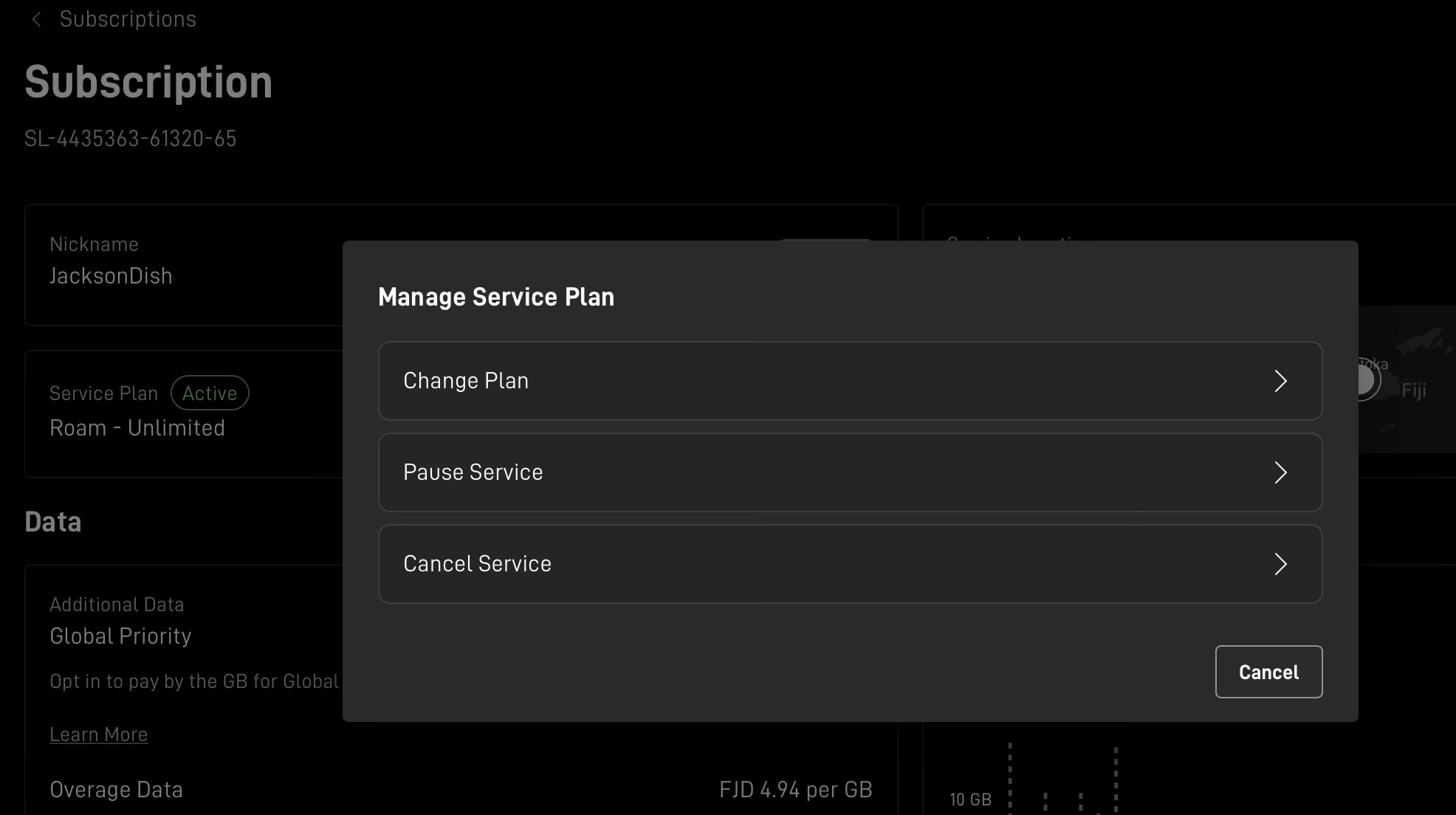
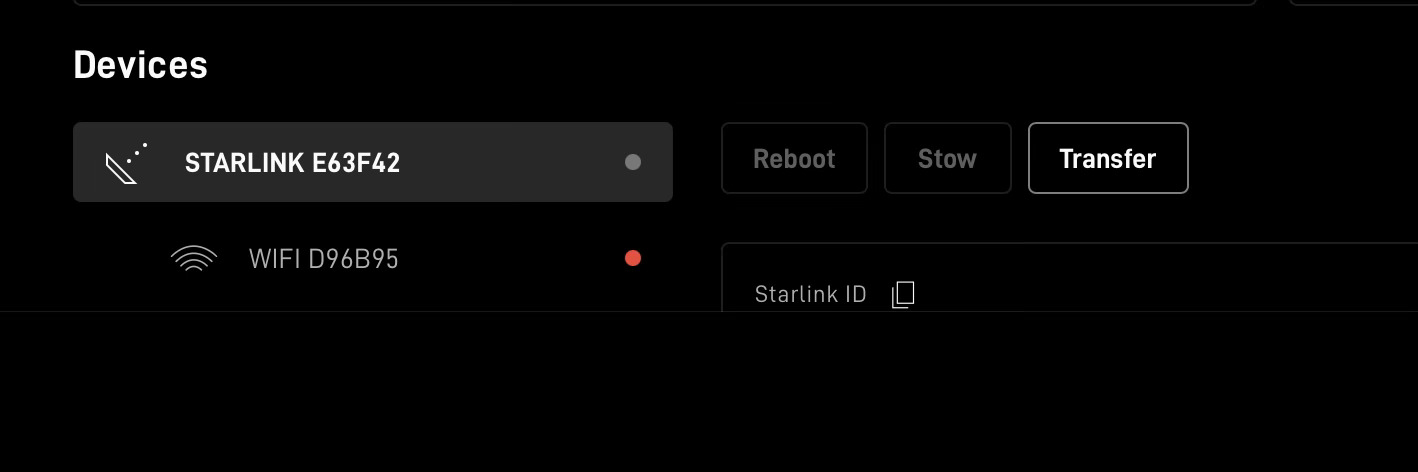
Transfer your dish
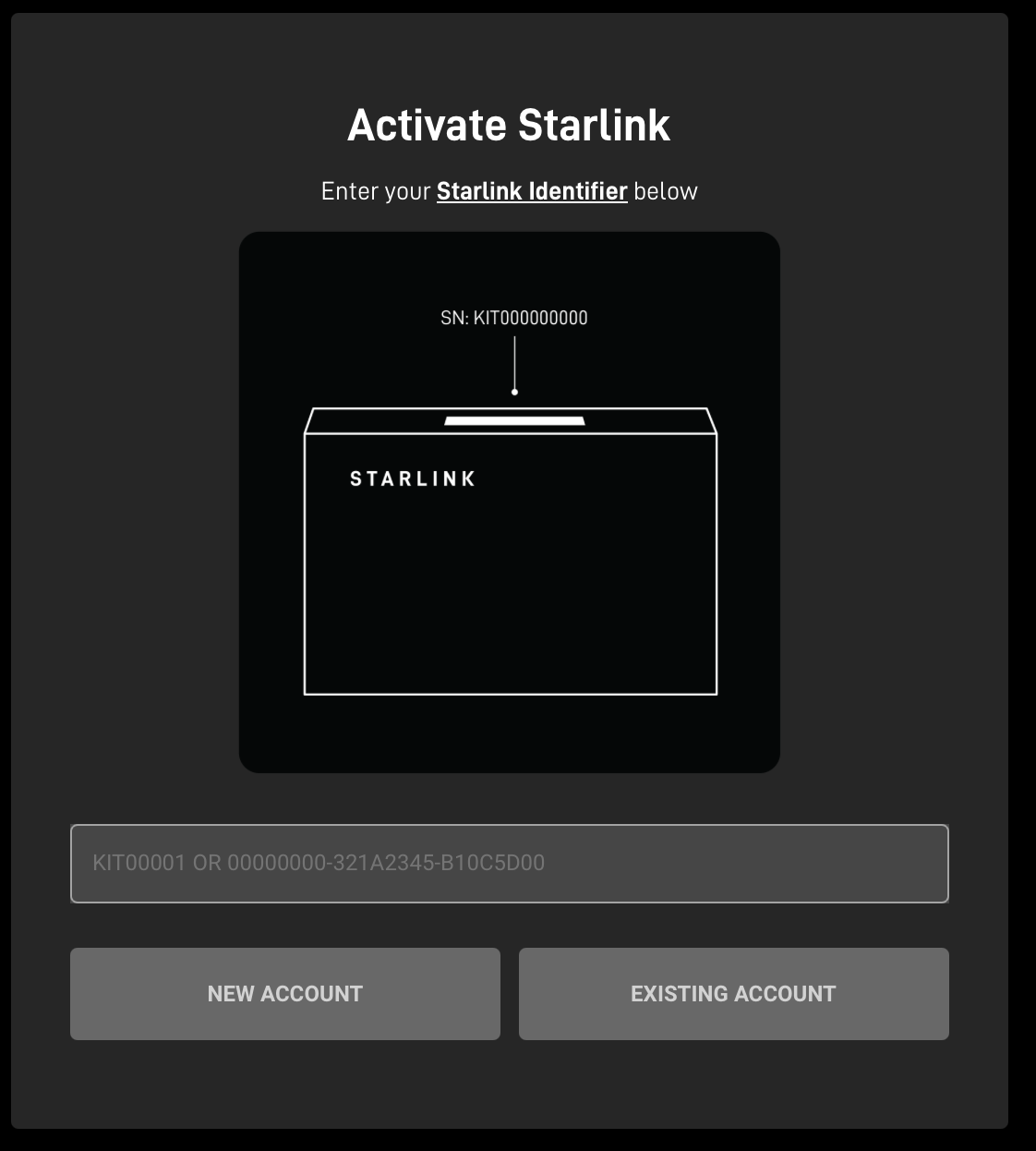
Activate your dish and select “New Account”
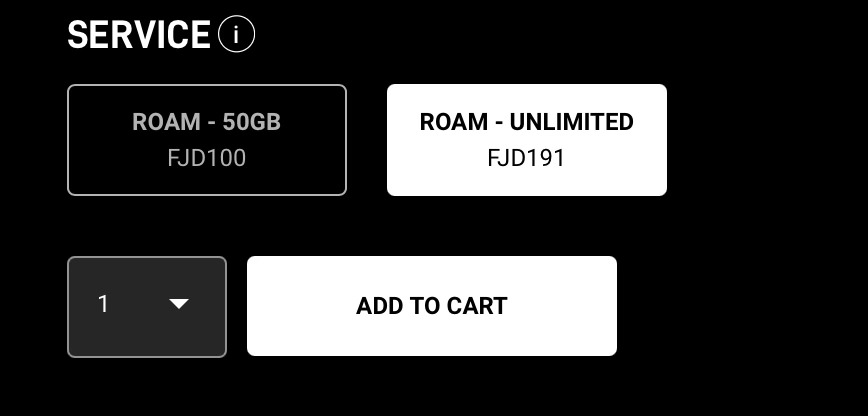
Follow the prompts to establish the account and payment method and select “Roam Unlimited" as your subscription option
If you want to keep using your same email address and you are a gmail user, you can use gmail’s alias feature. It makes it possible to avoid setting up a completely new email address for your new account.
Example: name@gmail.com becomes name+starlink2@gmail.com
Identity Verification
Starlink may require you to verify your identity. You'll get a message and a support ticket requesting you upload your passport and a selfie photo. This seems to apply to Roam plans. It's likely Starlink is complying with the "know your customer” laws that many countries have. Since your Roam plan means you could pop up in a country that requires Starlink to validate your identity, they are requiring this of all Roam customers.
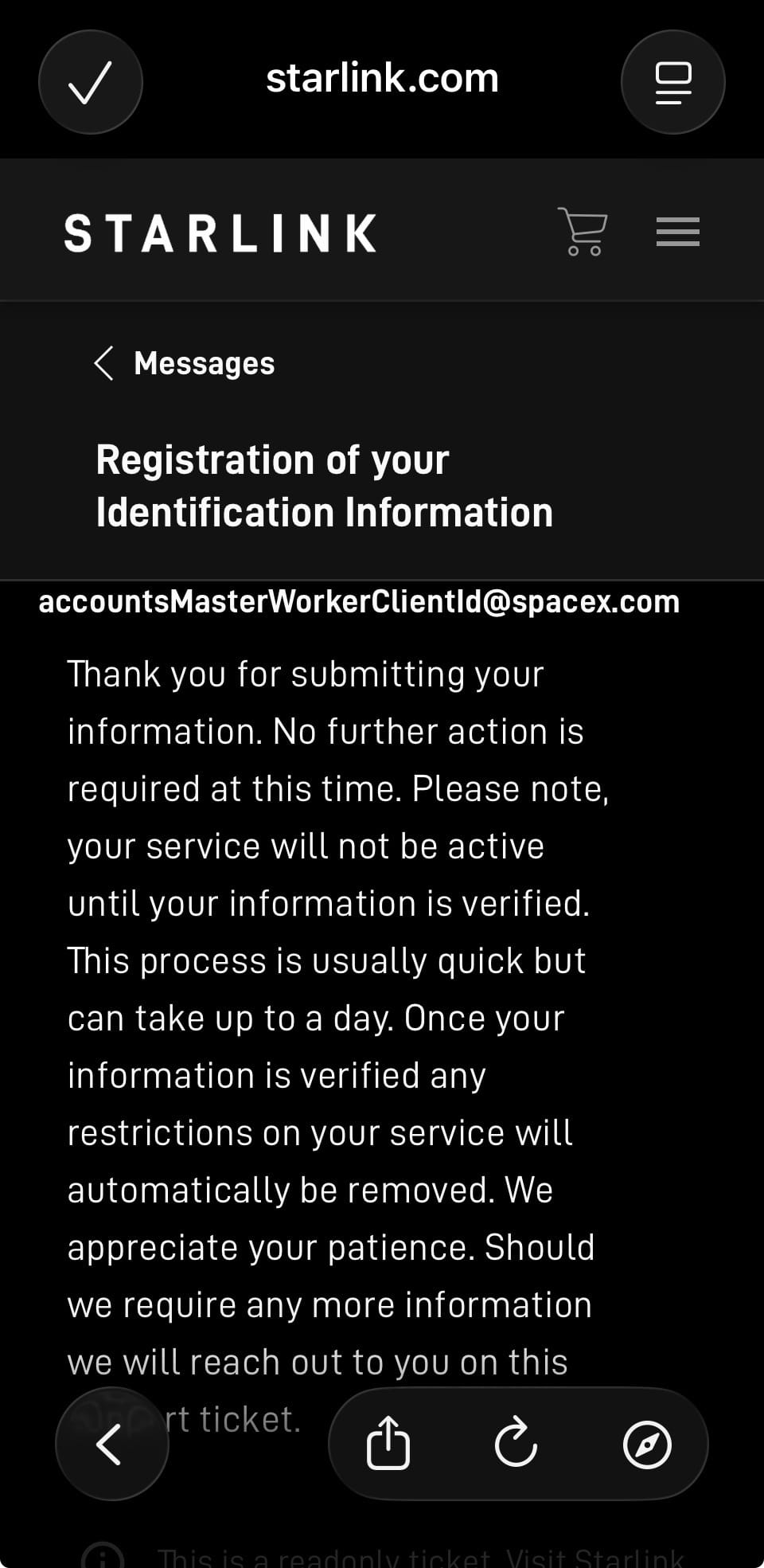
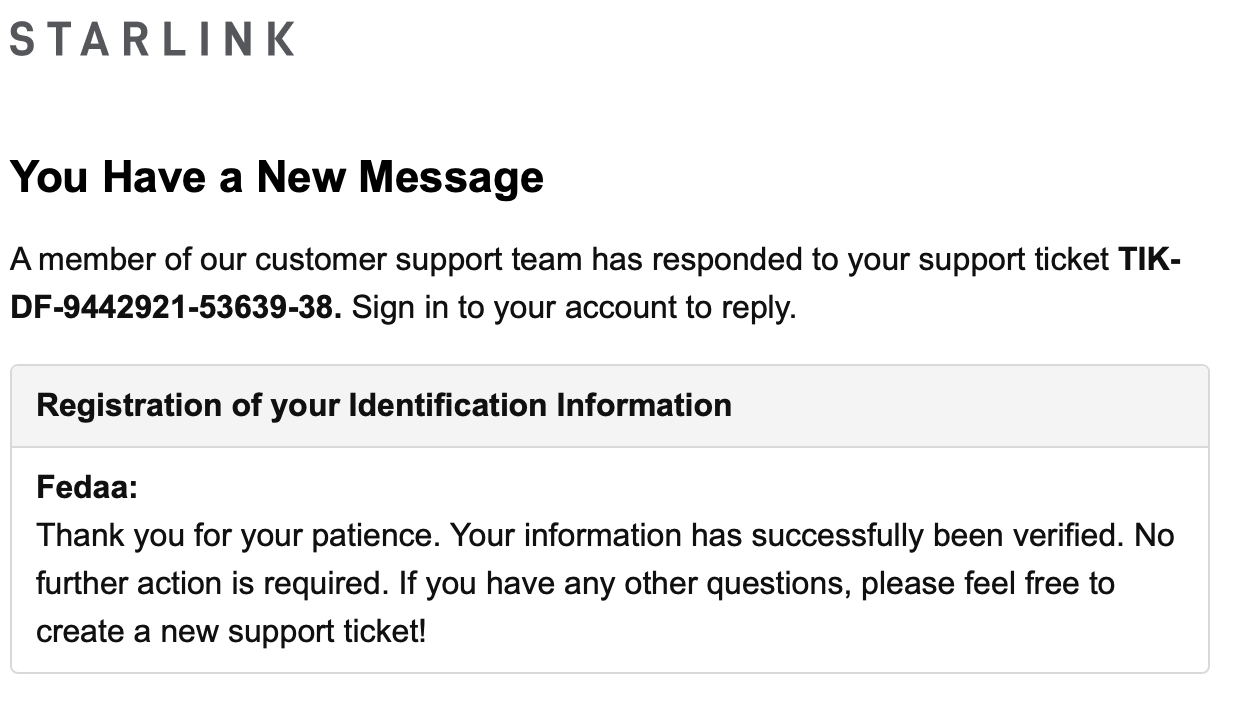
Starlink may require identity verification on your account.
Starlink hasn't made an official announcement on why they are requiring identity verification now. I'm inferring this from a support conversation I had.
Limitations on Transferring Your Dish
Some users have run into a limit on transferring their dish. You may not be able to transfer your dish if you recently purchased it or recently activated it. Nothing stops you from creating a support ticket explaining your situation and asking for an exception.
Transferring Services is not available until the earlier of (i) 120 days after you purchased your Starlink Kit, or (ii) 90 days after you activated your Starlink Kit.
Dish Choices
Any of the currently available dishes will work on a boat.
- Starlink Mini (25-40 watts)
- Starlink Gen2 (45-74 watts)
- Starlink Gen3 (75-100 watts)
- High Performance Dish (110-150 watts)
Our Gen2 dish draws about 30 watts. Sometimes a bit more when it's raining or we're moving. Since we are an AC-based boat our inverter is always running anyway so we don't incur any additional inverter overhead using Starlink. Boats who are DC-based and who don't run their inverter full time may benefit from the Starlink Mini's ability to be powered directly by the ship's DC system.
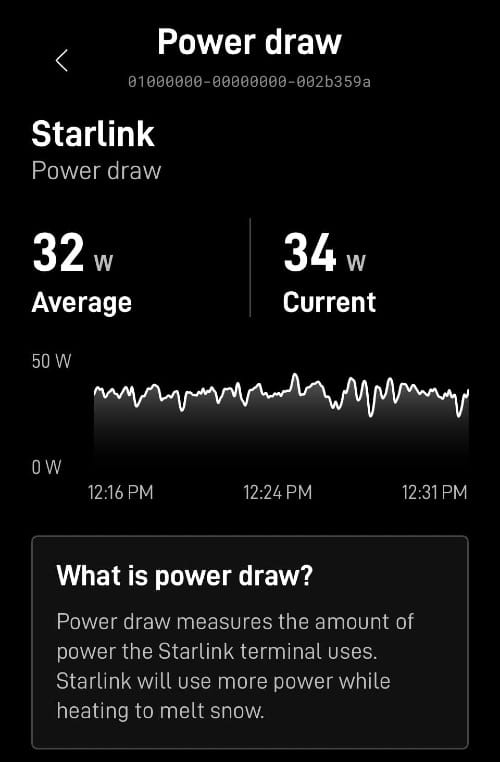
We are heavy internet users with frequent video calls (sometimes two going simultaneously). We've never seen the need for the high performance dish.
When we are off the grid we set the "sleep mode" on starlink so that it sleeps from about 11pm to 6am which saves a little energy.
Our Current Configuration
- Subscription Plan: Roam - Unlimited: 225FJD (~$103USD) per month
- Service Address: Fiji (Vuda Marina)
- Ocean Mode / Overage Data when away from land (more than about 12 miles):
- Hardware: Gen2 Dish Kit, Stock OEM Starlink router
- Dish Orientation: Automatic (not flat)
- Dish Motors: Working (not disabled)
- Mount: Generic rail mount from Amazon, mounted on stern rail behind the port helm.
- Spares: Gen3 dish kit and router, Spare cable (router to dish), Starlink Mini dish stowed in the ditch bag with a battery adapter.
Our Data Consumption
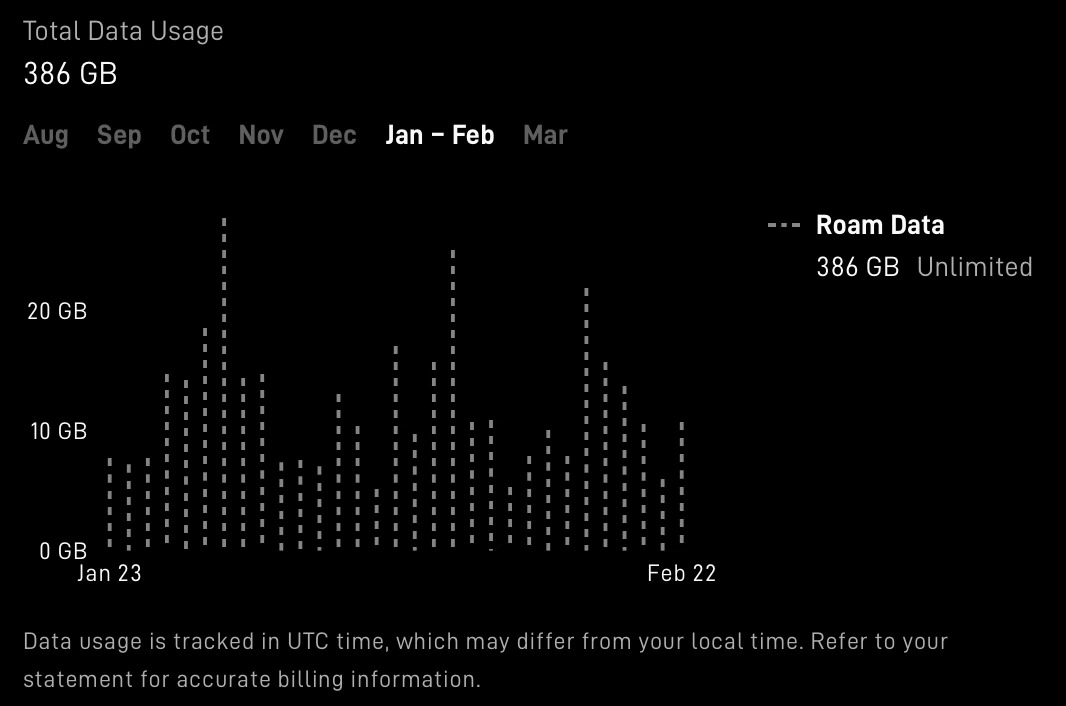
We use 300GB to 400GB of data each month when we are near land and running on “unlimited” data. This with no effort to control or manage the data usage of our various devices. We have two laptops, two iPhones, one iPad, one Smart TV, a PredictWind Datahub, and our Victron Cerbo all connected.
Offshore on a passage, we use about 4GB to 5GB per day provided we have our devices in “low data” mode.
Using Starlink Offshore with Roam Unlimited
Here is what Starlink has to say about “ocean-use” with the Roam Unlimited plan:
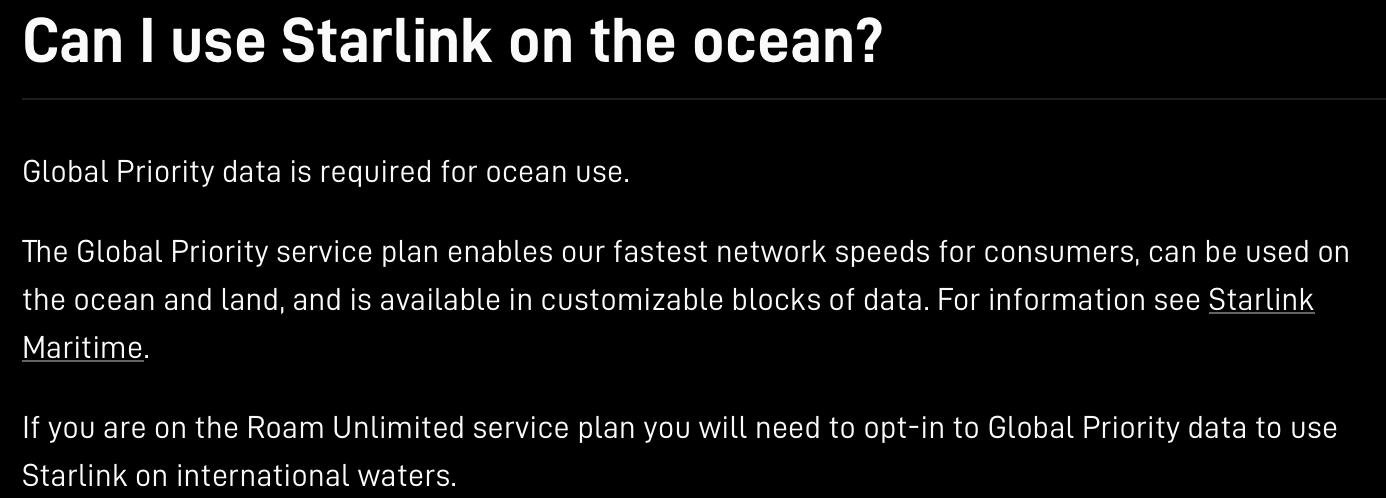
If you are on the Roam Unlimited service plan you will need to opt-in to Global Priority data to use Starlink on international waters.
Our Roam Unlimited plan has a “Global Priority” data toggle, similar to the old “Mobile Priority” toggle. We hope this means we can continue using the plan as usual.
Starlink may permit Roam Unlimited users to opt-in to purchase Global Priority data. Such permission may be revoked by Starlink in its sole discretion at any time.
What Happens Offshore?
If you don’t toggle on Global Priority data and you sail 12 miles away from land, you’ll see this:
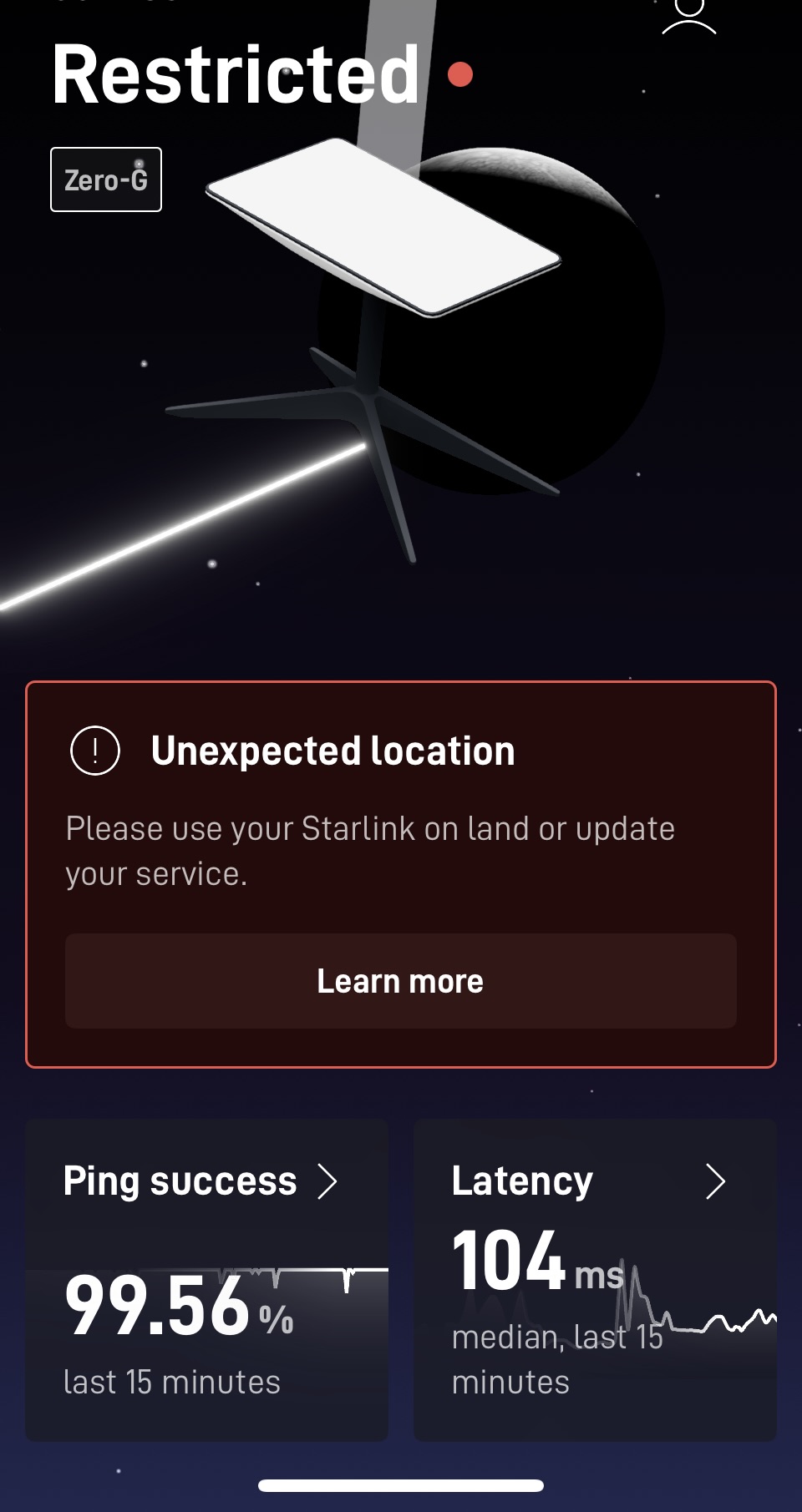
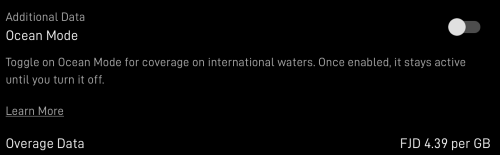
It means you need to toggle on Ocean Mode / Overage data. On short passages between islands we often don’t bother. A few hours of disconnected-ness isn’t a bad thing.
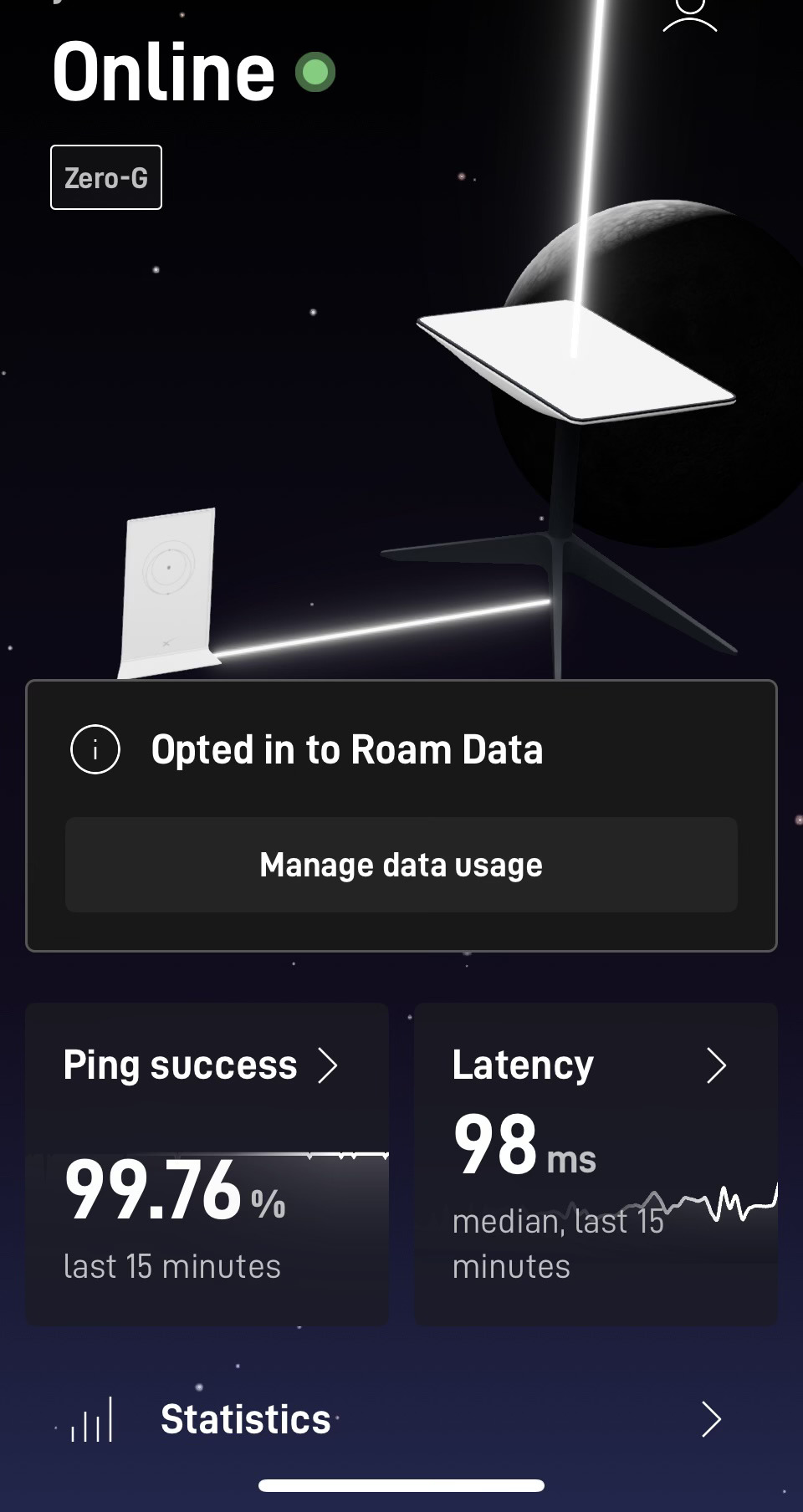
Gen2 Dish: Flat Orientation & Disabled Motors
Early on, there were far fewer Starlink satellites in the sky. There are over 7,000 operational satellites today. Back in 2022 when cruisers were starting to use Starlink, there were half that many. Some users found that forcing the dish flat and disabling the orientation motors (by drilling a hole in the bottom of the dish) resulted in faster acquisition times and better performance.
That is less of an issue today. However, there are times when we are at anchor and swinging around rapidly that we use the app to set the dish flat to improve the performance.
The latest Gen3 dish is flat and has no motors.
Gen2 Dish Reliability
We’ve recently had our third Gen2 dish suffer a failed GPS chip. This is not an uncommon problem with these dishes. The symptoms include:
Difficulty maintaining a connection while in motion
Slow to reacquire a connection
“Determining Location” message on the app screen never clears
Debug Data shows “ GPS is not valid”
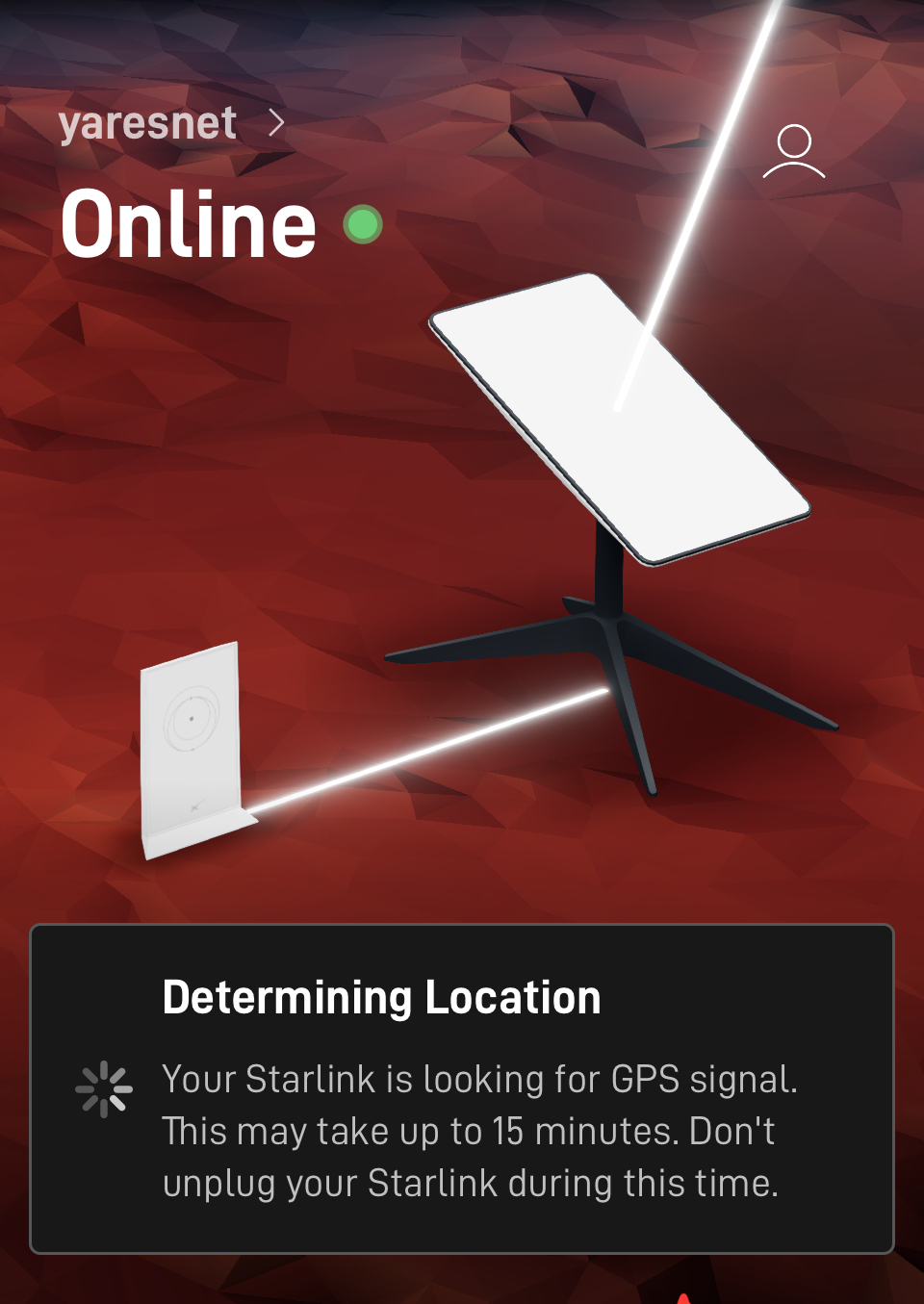
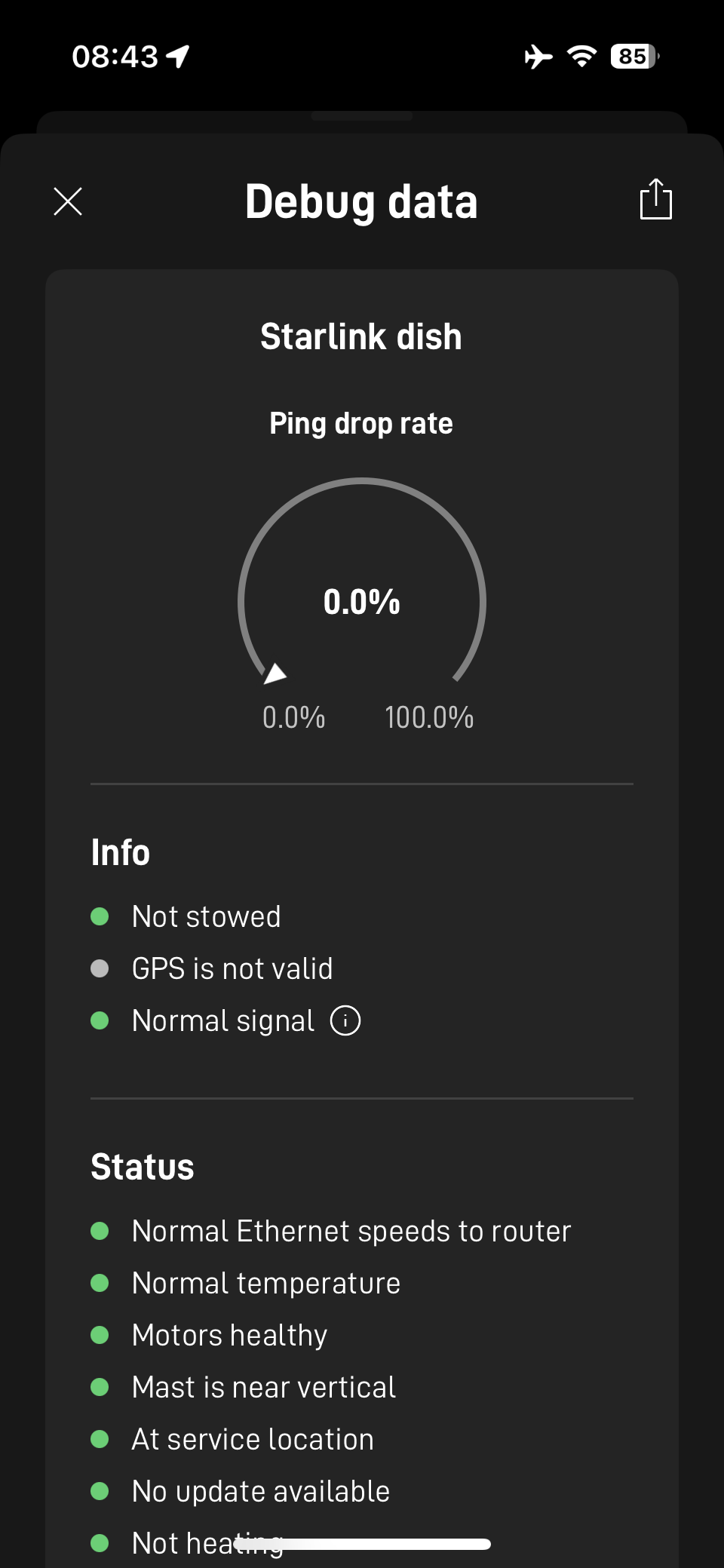
Starlink will replace the dish. It will be shipped to your service address. You can change and update the service address, but you can’t change countries. Our service address is currently in Fiji. When the last dish failed, our warranty replacement was sent to our service address in Fiji. We arranged for DHL to pick it up there and ship it to us in Tahiti. It took about 10 days. The shipping costs were what a new kit would have cost, but dish kits aren’t available in Tahiti, so it was worth it.
For our latest replacement, Starlink is shipping us a Gen3 dish. They no longer offer Gen2 dishes in our part of the world. We’ll need to work out a new mount for that.
We swapped out our spare Gen2 before we crossed the Dangerous Middle to Fiji. Once in Fiji we picked up the replacement Gen3 dish. The spare Gen2 dish is still on the stern rail. Now we also have a Starlink Mini dish (in the ditch bag) which is what we'd likely use if this Gen2 dish fails.
Activating a Spare Starlink Dish
We needed to swap out our failed Gen2 dish with a spare. We’ve got a long passage coming up, and the failed dish won’t hold a connection while we are sailing.
It was easy to do. www.starlink.com/activate. The activation site will ask if you want to open a new account or activate your spare dish on your existing account. We chose the latter. It lets you select the subscription plan specific to that dish. We stayed with a Fiji-based Roam Unlimited plan.
Once the spare dish was up and running for two days, we paused the subscription on the failed dish. That way, we don’t have to pay for two subscriptions.
I needed an internet connection to complete this process. Do it when you have 4G/5G cellular access or before your current dish completely fails (my method here).
Make sure your spare dish is free from a previous account and has been “transferred.”
For now, we are back in action!

What is the Deal with Starlink and French Polynesia?
Starlink is not available in French Polynesia. You can’t buy the equipment here, and you can’t subscribe to the service here. You can’t use a French Polynesia service address.
Recent reports suggest you can’t get a Starlink dish kit shipped here anymore (we were able to get a warranty replacement shipped to Tahiti back in September 2024).
Starlink has to negotiate tariff and operating agreements with each regulator in each country in which it sells its equipment and service. It is a herculean legal and business development challenge. That accounts for the different prices and experiences subscribers have among various countries.
OPT/Onati Monopoly and OneWeb/EutelSat
French Polynesia has granted their external telecommunications monopoly to the incumbent operator, Office des Postes et Télécommunications (OPT), and its operational subsidiary, Onati. OPT/Onati’s stated strategy is to partner with OneWeb (owned by EutelSat) for satellite-based internet. Availability of a solution from them was scheduled for the first quarter of 2025. That did not happen. No specifics about services and pricing have been announced.
Whether OPT/Onati eventually launches a service and whether it is competitive with Starlink remains to be seen.
Permission to Import Starlink Dish Kits
There is a case currently before the administrative tribunal in Papeete. This case specifically challenges an administrative decision banning the importation of Starlink antennas into French Polynesia. It is reportedly the first such refusal to be formally adjudicated by the tribunal. The outcome of this case may determine whether sailors and residents can import Starlink dish kits into French Polynesia.
That was the July 2025 case. Since then: the tribunal ordered the Pays to allow four individuals to import Starlink kits and annulled the July 2025 order that allowed customs to block the antennas, on the grounds that the executive rather than the assembly lacked competence to set the rules; the government's clarifying bill had to be withdrawn from debate at Tarahoi; and a separate October order still restricts imports. Use remains prohibited.
As of July 2026, Starlink service and antennas remain regulatorily banned in Polynesia with a few exceptions, and OPT retains its monopoly on the international connection.
Our Experience
Starlink is a game changer (an overused expression but true in this case). It has allowed me to build and run a global consulting business while sailing across the Pacific and through French Polynesia. We stay in daily contact with our friends and family through phone and video. It enables luxuries like watching movies, popular shows, and the NFL Super Bowl streamed to our computers or television.
For sailing and passage making, you can’t beat instantaneous access to weather information. It is helpful to access the current satellite loop to determine what you will soon face or how long you’ll be dealing with the current conditions. Before Starlink, the best we got was a single satellite image download that might be half a day old.
It’s not without its drawbacks. It changes the nature of the cruising experience. We are still nearly as “connected” as we were back home. It has largely killed off the HF Radio nets on HAM and SSB as well as the local VHF morning cruiser’s net. Those have been replaced by WhatsApp groups, Facebook groups, and apps like NoForeignLand.
People complain about Starlink changing its plans and terms. This is the nature of iterative development. Try new things. Keep what works. Abandon or change what doesn’t. That approach is what gets you high-speed, low-latency internet in the middle of the ocean at an affordable price (in your cruising lifetime).
People hate change and unpredictability. If you want predictability and stability, you’ll get your cable company (or your mobile carrier). And they don’t have high-speed internet in the middle of the ocean (and likely never will).
Not everyone loves Starlink. We get it. But we wouldn’t go back.
Thank you to Ian Clarke and Chris Rabbidge for their editorial contributions to this post.
Disclaimer: This is based on our direct experience right now. The situation could change at any time. Starlink’s enforcement of its terms and conditions varies by location. What we experience here in the South Pacific may not be what you experience where you are.
Anyone who claims to know what Starlink will do in the future is just guessing. Nobody knows what will change.
We have no affiliation with Starlink or SpaceX other than that of a subscriber.
Comments
Hi Jim, I stumbled across this post and thought I would share my recent experience getting rid of Starlink... I now live in a fairly rural area of Chile and internet options are limited at best. I'd had Starlink for about 3 years and I was fairly happy with it. However, with the situation in the States, I wanted another option.. and here's what I found. Cheers! John https://mundanemarvels.substack.com/p/kicked-to-the-curb
Thanks! Sounds as though you found a workable alternative. For a cruising sailboat in the ocean or anchored off an uninhabited island, Starlink is the only option for cost effective, reliable, high-speed Internet. 4G/5G doesn't reach out here. "Game changer" is an over-used phrase but it fits here. It borders on miraculous.
Starlink has to negotiate tariff agreements with each regulatory agency in every country in which sells its equipment and service. Some countries haven't allowed them to sell their equipment and service--French Polynesia for example. One reason is the entrenched cellular providers wield their political power to block Starlink from operating in their country. It makes sense. These carriers made big infrastructure investments to provide wireless broadband services. They expect to recoup that investment over a long period of time. Starlink is a threat to that revenue stream. Unfortunately, it's the citizens who suffer when they can’t get access to affordable high-speed, low-latency Internet.
Other than as a subscriber, I have no affiliation with SpaceX or Starlink.
Hey Jim! Thank you for the great article and all of the details! We were in the Republic of the Marshall Islands and had Starlink disconnected as we were outside of our service area (New Zealand) for more than 60 days. We were actually away for almost a year before we got cut off. We ended up changing our service address (from NZ to Fiji) and were reinstated (despite the fact that we were not in Fiji (yet). It took a lot of emails back and forth to get reinstated along with photos of our departure paperwork from RMI.
We are in route to Fiji now and all is working with the Fiji Roam Unlimited plan that is currently switched to Global Priority (as we are underway).
We will use Fiji Roam Unlimited in Fiji until we get to New Zealand where we will switch back to a NZ address. That is of course unless SL forces us to switch to the non-unlimited plans.
We shall see
First, I am sending positive energy your way for a safe finish to your passage to Fiji. I know it has been eventful!
Thanks for sharing your experience getting moved on to the Roam-Unlimited plan. I'm hoping it remains a viable option for all of us out here cruising.
Jim, that's an AMAZING article! Many thanks indeed!
Maybe you and Pam should change the name of your boat to “Roam Unlimited!”
Ha! If we ever change Starlink plans we'll have to change the boat name. "Global Priority" does have a nice ring to it, though.
Great article! Thanks for this first hand information. I will travel to Fakarava for about 3 weeks this October. I am planning if I should bring my starlink mini with me.
cmiiw, from your article, my understanding is starlink is not working when you ancharing at fakarava as it is close less than 12 miles from shore. Even in-motion ocean mode is not helping.
Your Starlink will will work fine in Fakarava. Roam-unlimited works well. You won't need to use ocean mode. We spent many months there with no problems.
Holly Molly. I liked our ham radio. Old school. Sure sounds complicated and tiresome. At least for me reading that. 🤣🥴
Have fun. I’m sure you helped a few people or lost them. 😳😳🤔🤣
I miss our HAM days as well. Those nets were always a great source of entertainment. I loved sailing into a new anchorage and meeting live the people we had been talking to on the radio for months.
Those days are gone. All of that communication has moved to WhatsApp groups and apps like NoForeignLand (and Facebook groups although the signal-to-noise ratio on Facebook is as horrible as you would think it would be).
The same is true of the VHF radio. Few boats keep their radios on these days. Our VHF installation is optimized for AIS, not voice (although we still keep our VHF on out of habit).
In an emergency, the very first "Maday" call goes out over WhatsApp via Starlink.
At first it was the growing ubiquity of shore-based 3G and 4G cell network that made this possible. Now it's Starlink. It's nothing short of miraculous how well it works and how cheap an accessible it has made high-speed, low-latency internet in the middle of the ocean. Nothing else comes close. The last figure I saw was that more than 85% of the cruising boats in the South Pacific had Starlink aboard.
73,
KO6JJ
❤️
I just wrote an overview of our communications on board. I’m going to link your post where I mention Starlink if you don’t mind. You did a great job!
We still use ham, I got super into POTA as well. So much fun!
K0NAH
Ah. What a great call sign!